
The Pig Sex-determining Region Y (SRY) protein is a critical marker used in the identification of genetic sex in pigs. The SRY gene, located on the Y chromosome, plays a pivotal role in initiating male sex determination by triggering the development of male-specific pathways during embryogenesis. Monitoring the expression of this protein is essential for various research and veterinary applications, including sex determination in pig breeding, genetic studies, and understanding sex-linked traits. This is where the Pig SRY Protein ELISA (Enzyme-Linked Immunosorbent Assay) becomes invaluable as a precise and reliable diagnostic tool.

What is the SRY Protein?
The SRY protein, encoded by the SRY gene, functions as a transcription factor that is crucial for male differentiation. It initiates the male pathway by activating downstream genes necessary for testes development. Variations or mutations in the SRY gene can lead to disorders of sex development (DSD) in pigs, making its detection vital for research and clinical applications. You can learn more about the genetic and functional aspects of the SRY gene through NCBI and NIH resources.
The Importance of Pig SRY Protein ELISA
Pig SRY Protein ELISA kits are specifically designed to detect and quantify the presence of the SRY protein in samples. This quantitative approach provides critical insights into genetic sex determination, ensuring accurate classification of pig samples based on the presence or absence of the SRY protein. The use of ELISA kits for this purpose is widely supported by various academic studies available on PubMed and other research platforms.

Applications in Veterinary and Genetic Research
- Sex Determination: ELISA kits for SRY protein are predominantly used for determining the sex of pigs in early embryonic stages. This application is vital for breeders aiming to control the sex ratio for commercial purposes. Research on the use of SRY gene markers for sex determination can be found at the USDA and ARS.
- Genetic Studies: SRY protein assays are also employed in genetic studies to understand the genetic basis of sex-linked traits and disorders in pigs. For more information, consult the National Institute of General Medical Sciences and Animal Genetics Resources.
- Breeding Programs: Understanding the genetic sex of pigs can enhance breeding programs, helping to improve herd management and production outcomes. Additional insights are provided by FAO and the World Organization for Animal Health.
Advantages of Using Pig SRY Protein ELISA
- High Sensitivity and Specificity: The ELISA kit offers high sensitivity and specificity, ensuring accurate results even with low concentrations of the SRY protein. Details on assay development and performance standards can be found at CDC and FDA.
- Quick and Reliable: Compared to traditional genetic tests, ELISA is faster, providing results within a few hours. This efficiency is crucial for large-scale breeding operations. Learn more about assay techniques.
- Cost-effective: The ELISA method is more cost-effective than other genetic testing techniques, making it accessible for routine use. For more on cost-benefit analysis in diagnostics, refer to NIH.
Methodology of Pig SRY Protein ELISA
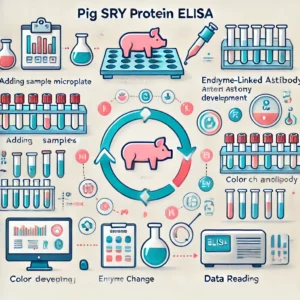
The ELISA method involves coating a microplate with antibodies specific to the SRY protein. When a sample is added, any SRY protein present will bind to the antibodies. Subsequent steps involve the addition of enzyme-linked antibodies and a substrate that produces a measurable color change. The absorbance can be quantified using a microplate reader, giving a precise indication of the SRY protein concentration. Detailed protocols for ELISA are available at National Institutes of Health and CDC Laboratory Protocols.
Challenges and Considerations
While the Pig SRY Protein ELISA offers numerous advantages, there are challenges such as the potential for cross-reactivity with other proteins, which can affect accuracy. Ensuring proper sample preparation and following standardized protocols, as outlined by organizations like ISO and AOAC, can help mitigate these issues.
Future Prospects in Sex Determination
Advancements in biotechnology continue to improve the sensitivity and accuracy of SRY protein assays. With ongoing research, there is potential for even faster, more cost-effective methods for sex determination in pigs. Studies from leading research institutions like MIT and Harvard are paving the way for innovations in this field.
Conclusion
The Pig SRY Protein ELISA is a critical tool for researchers and breeders, offering a reliable and efficient method for genetic sex determination. Its applications extend beyond simple sex identification, playing a role in understanding genetic conditions and enhancing breeding programs. For more detailed information and further reading, explore resources available on PubMed, CDC, and USDA.
The increasing use of Pig SRY Protein ELISA kits represents a significant step forward in veterinary diagnostics and research, contributing to more precise breeding strategies and a deeper understanding of genetics in swine.