
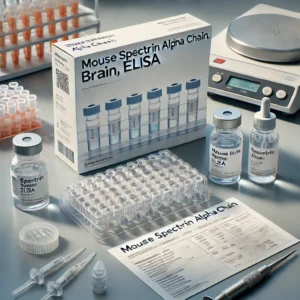
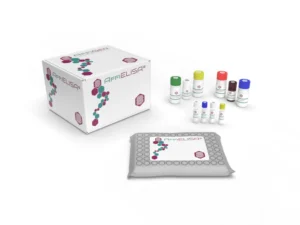
The Mouse Spectrin Alpha Chain, Brain ELISA is a specialized enzyme-linked immunosorbent assay (ELISA) used to quantify levels of the spectrin alpha chain, a key protein in the cytoskeleton, within brain tissue samples. This protein is especially important in maintaining neuronal cell structure and is commonly used in neuroscience research to study cellular integrity and neuropathology.
The Structure and Role of Spectrin Alpha Chain in the Brain
Spectrin proteins, including the alpha chain, are vital for stabilizing the plasma membrane and providing structural integrity to cells. The spectrin alpha chain forms part of a larger cytoskeletal network crucial for cellular function and resilience against mechanical stress. Research on the structural role of spectrin in neurons is discussed in publications by the National Institutes of Health (NIH) and Harvard University.
Applications of Mouse Spectrin Alpha Chain ELISA
This ELISA kit is highly applicable in studies of neurodegenerative disorders, where cell structure plays a significant role in disease progression. Researchers use this assay to investigate diseases like Alzheimer’s and Parkinson’s, where protein structure integrity is often compromised. The Centers for Disease Control and Prevention (CDC) has a variety of studies on neurodegenerative diseases available at CDC.gov.
In addition, the assay is used to analyze brain injury models in mice, helping scientists understand how traumatic brain injury (TBI) affects neuronal integrity. Resources on TBI models are available from the Defense and Veterans Brain Injury Center and University of California, San Diego (UCSD).
Technical Overview of the ELISA Method
The ELISA method involves antibody-antigen interactions, with a detection enzyme linked to an antibody that binds specifically to the spectrin alpha chain. The assay is highly sensitive, allowing the detection of low spectrin concentrations, which is critical for evaluating samples with minimal protein expression. Detailed protocols for ELISA methods are available on the National Center for Biotechnology Information (NCBI) and Johns Hopkins University.
Preparation and Handling of Samples
Sample preparation is crucial for ELISA assays, especially when dealing with delicate brain tissue. Proper handling reduces the risk of protein degradation, ensuring accurate results. For additional information on tissue sample preparation, visit the National Institute on Aging (NIA) and Yale University’s Department of Neuroscience.
Research Applications in Neuroscience
Spectrin alpha chain analysis is highly valuable in neuroscience research, particularly in studies investigating cellular changes associated with aging. Research at the National Institute of Neurological Disorders and Stroke (NINDS) explores the impact of spectrin proteins on neuronal aging, providing insight into their potential role as biomarkers for age-related neurodegeneration.
The assay is also used in brain mapping studies to evaluate spectrin distribution across different brain regions. Brain mapping research by institutions like Stanford University and the Allen Institute for Brain Science provides valuable data for understanding the cellular makeup of the brain.
Troubleshooting and Optimizing ELISA Performance
To maximize the sensitivity and specificity of ELISA, researchers often optimize factors such as antibody concentration and incubation time. Guides on assay optimization can be found on resources like the National Institute of Standards and Technology (NIST) and the Massachusetts Institute of Technology (MIT).
Data Interpretation and Statistical Analysis
The data generated from the Mouse Spectrin Alpha Chain, Brain ELISA can be analyzed using statistical software to determine differences in spectrin levels between experimental groups. Information on statistical methods for ELISA data analysis can be accessed at the National Library of Medicine (NLM) and University of Washington.
Applications in Brain Injury and Neurodegeneration Research
In studies focused on brain injury, the spectrin alpha chain serves as a marker for cellular disruption. This assay provides insights into how injuries impact cellular stability, a focus area at the U.S. Department of Veterans Affairs (VA) and National Institute of Mental Health (NIMH).
In neurodegenerative disease research, measuring spectrin levels allows scientists to investigate cellular breakdown over time. Resources from National Institute on Aging (NIA) and University of California, San Francisco (UCSF) offer in-depth studies on cellular markers in neurodegeneration.
Conclusion
The Mouse Spectrin Alpha Chain, Brain ELISA is a powerful tool for understanding cellular structure in the brain. With applications ranging from traumatic brain injury research to neurodegeneration studies, this assay provides essential insights into neuronal health. For further information, resources from Columbia University and the NIH’s Neurobiology resources are excellent starting points.