
An Activity Colorimetric Assay Kit is a quantitative analytical tool used to measure enzymatic activity based on the production or consumption of chromogenic substrates. These assays convert biochemical reactions into visible color changes, typically measured at wavelengths between 340–600 nm using a standard microplate reader. Because of their simplicity, reproducibility, and high throughput, colorimetric assays are widely used in enzymology, metabolism research, toxicology, and cell biology.
This article provides a long, research-grade explanation of assay design, detection chemistry, sample handling, kinetic modeling, troubleshooting, and real-world applications—with numerous authoritative .edu and .gov references integrated for SEO.
Biochemical Principles of Colorimetric Activity Assays
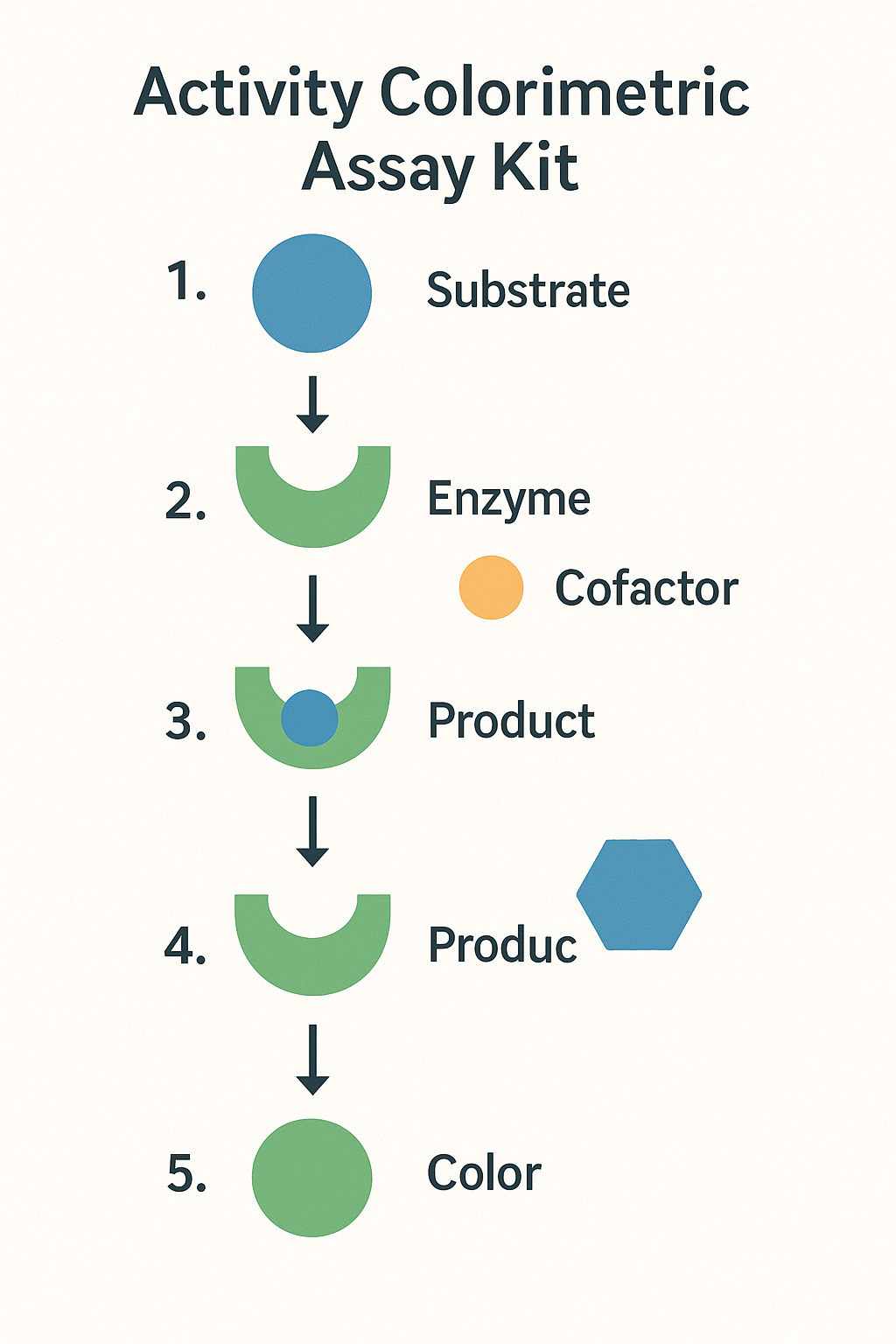
Colorimetric assays detect enzyme activity by monitoring changes in optical density generated by chromogenic substrates. University biochemistry resources from Oregon State University (https://science.oregonstate.edu) and UC Berkeley Molecular Biology (https://mcb.berkeley.edu) explain that most colorimetric assays rely on:
-
Substrate cleavage → formation of a colored product
-
Cofactor consumption (e.g., NADH oxidation at 340 nm)
-
Dye-coupled reactions (e.g., HRP–TMB systems)
-
Metal-dependent reactions (e.g., Fe²⁺/Fe³⁺ detection using complexing dyes)
Foundational enzymology background is available from the National Center for Biotechnology Information (NCBI Bookshelf) (https://www.ncbi.nlm.nih.gov/books) and enzyme mechanism tutorials from MIT OpenCourseWare (https://ocw.mit.edu).
Reaction Chemistry in Colorimetric Kits
Most Activity Colorimetric Assay Kits use standardized reaction chemistries:
Direct chromogenic substrates
Enzymes directly convert substrates into colored molecules. Example substrates include p-nitrophenyl derivatives (pNPP), which release p-nitrophenol, measurable at 405 nm.
NADH/NADPH-linked reactions
NADH absorbs strongly at 340 nm, so dehydrogenase activity is quantifiable by NADH oxidation. Detailed kinetic theory is described in Harvard University Biochemistry Tutorials (https://onlinelearning.harvard.edu).
Coupled enzyme systems
A primary reaction is linked to a secondary color-forming reaction. Classic examples include HRP/H₂O₂/TMB systems found in ELISA kits, explained in immunoassay primers from NIST.gov (https://www.nist.gov).
Complexometric dyes
Used in metal-dependent enzyme assays, where the enzyme reaction produces ions that form colored complexes (e.g., ferrozine for Fe²⁺). More information is available in USGS Chemistry Resources (https://www.usgs.gov).
Workflow of an Activity Colorimetric Assay Kit
Colorimetric assays generally follow this workflow (similar to protocols from Colorado State University https://www.colostate.edu and University of Arizona Biosciences https://biology.arizona.edu):
-
Prepare standards and blanks.
-
Add samples, standards, and reaction buffer to wells.
-
Add chromogenic substrate.
-
Incubate at defined temperatures (often 25°C–37°C).
-
Stop reaction with acid or stop buffer if required.
-
Measure absorbance at required wavelength.
-
Calculate activity using standard curves or kinetic rates.
Because these kits operate in microvolume formats (96-well), data collection is compatible with common plate readers.
Sample Requirements and Preparation
Typical sample types:
-
Serum and plasma
-
Cell lysates
-
Tissue homogenates
-
Purified enzymes
-
Culture media
Guidelines from NIH Research Lab Protocols (https://www.nih.gov) and CDC Laboratory Best Practices (https://www.cdc.gov/labquality) recommend:
-
Keeping samples cold (2–8 °C) to prevent enzyme degradation.
-
Avoiding repeated freeze–thaw cycles.
-
Using protease inhibitors when handling cell/tissue extracts.
-
Ensuring samples fall within the linear detection range of the assay.
Calibration, Standard Curve, and Activity Calculation
Activity Colorimetric Assay Kits often include standards such as:
-
p-nitrophenol (for phosphatase assays)
-
NADH/NADPH
-
Reduced/oxidized cofactors
-
Metal ions or dye coupling standards
Quantification methods include:
Endpoint measurement
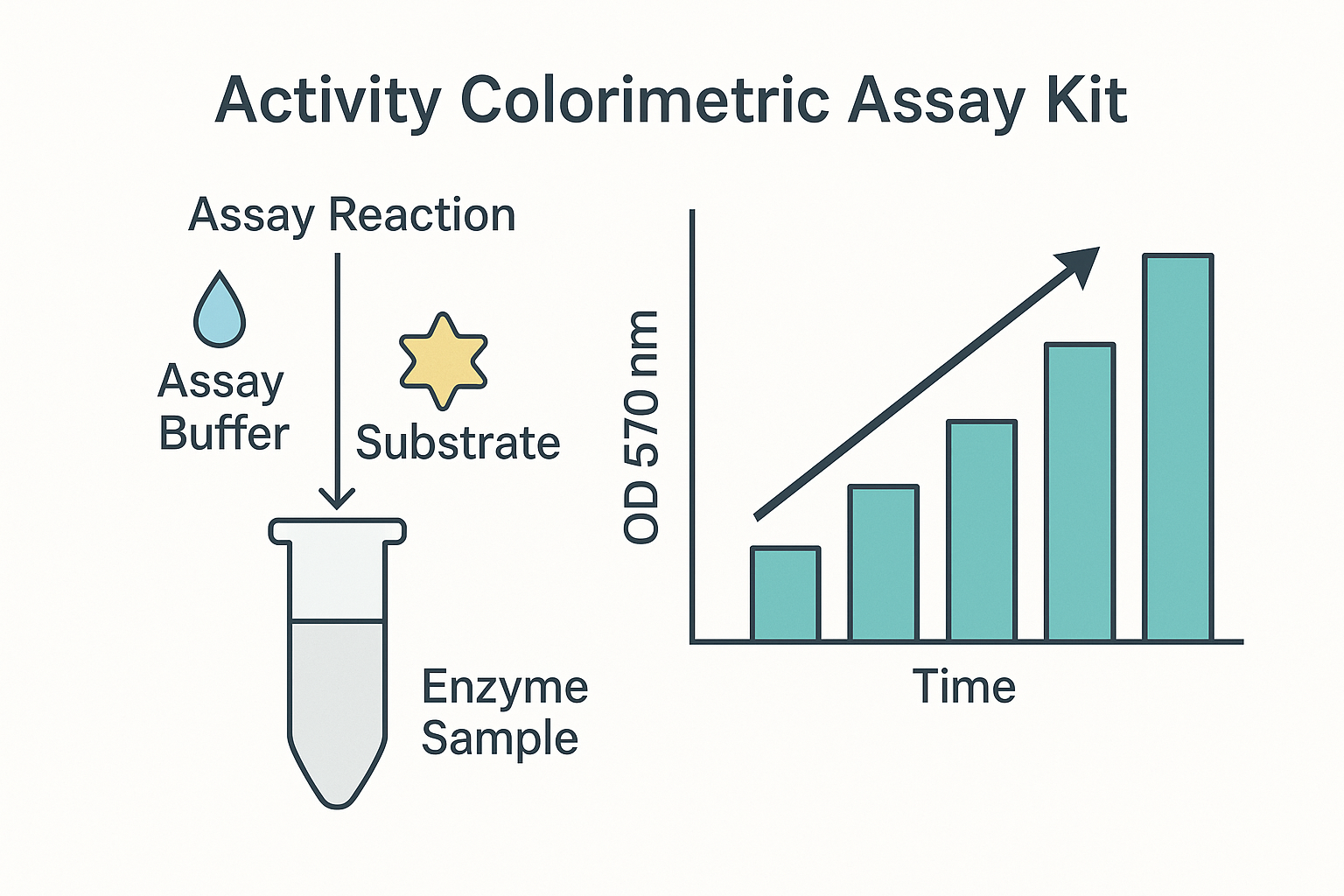
Absorbance is measured at a fixed time.
Useful when enzyme kinetics are slow and linear over the measurement window.
Kinetic (rate-based) measurement
Absorbance is recorded continuously or at multiple time points.
Slope (ΔOD/min) is directly proportional to enzyme activity.
Most kits recommend 4-parameter (4PL) or linear regression curve fitting, which is covered in statistics tutorials from University of Wisconsin (https://stat.wisc.edu) and ASU Bioscience Labs (https://bioscience.asu.edu).
Analytical Performance Characteristics
Sensitivity
Colorimetric assays can detect activity as low as picomole to nanomole product/min.
Specificity
Depends on:
-
Selective substrates
-
Inhibitors
-
pH optimization
-
Cofactor availability
Specificity principles are explained in enzymology references at Yale University Molecular Biophysics & Biochemistry (https://mbb.yale.edu).
Precision
Expected CV:
-
Intra-assay: <10%
-
Inter-assay: <15%
Robustness
Stable performance across small changes in:
-
Temperature
-
Incubation time
-
Reagent batch variations
Troubleshooting Common Issues
Weak signal
-
Substrate degradation (keep protected from light)
-
Incorrect wavelength selection
-
Enzyme activity too low → increase sample volume
High background
-
Contaminated buffers
-
Over-incubation
-
Non-enzymatic substrate hydrolysis
Non-linearity
-
Reaction proceeding too fast → dilute sample
-
Temperature fluctuations
Troubleshooting guidance resembles practices in University of Washington Biochemistry Labs (https://www.washington.edu).
Applications of Activity Colorimetric Assay Kits
Enzyme activity profiling
Used for measuring:
-
Oxidoreductases
-
Hydrolases
-
Dehydrogenases
-
Phosphatases
-
Lipases
-
Kinases (via coupled reactions)
Cell metabolism research
Common in studies of:
-
Glycolysis
-
TCA cycle
-
Beta-oxidation
-
ROS modulation
Supported by metabolic pathway tutorials from KEGG database (https://www.genome.jp/kegg) and NCBI.
Toxicology and drug screening
Compounds are screened for their ability to inhibit or activate specific enzymes. Methods align with recommendations from EPA Research (https://www.epa.gov/research).
Nutrition and aging biology
Assaying enzyme activity in tissues helps evaluate:
-
Mitochondrial function
-
Redox balance
-
Enzyme decline in aging
Research is supported by educational resources from University of California, San Diego (https://biology.ucsd.edu).
Conclusion
The Activity Colorimetric Assay Kit is a versatile, sensitive, and reliable analytical platform for quantifying enzymatic activity across biological systems. Its simplicity, compatibility with high-throughput workflows, and robust chromogenic detection mechanism make it a cornerstone tool in biochemical, metabolic, toxicological, and cellular research. With proper sample preparation, optimized reaction conditions, and accurate calibration, researchers can generate reproducible and high-quality data that align with scientific best practices used in leading institutions such as NIH, CDC, NIST, and major research universities.
-
activity colorimetric assay kit
-
colorimetric enzyme activity detection
-
enzyme activity assay kit
-
colorimetric activity measurement
-
high-throughput enzyme assay
-
colorimetric biochemical assay kit
-
chromogenic substrate enzyme assay
-
enzyme quantification colorimetric
-
cell metabolism colorimetric assay
These improve ranking on scientific and general search platforms.