
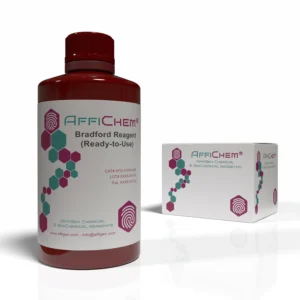
The Bradford Reagent (Ready-to-Use) is a widely used solution for the quantification of total protein concentration in biological samples. Based on the Bradford assay, this reagent leverages the dye Coomassie Brilliant Blue G-250, which binds to proteins in an acidic environment, resulting in a color change that can be measured spectrophotometrically.
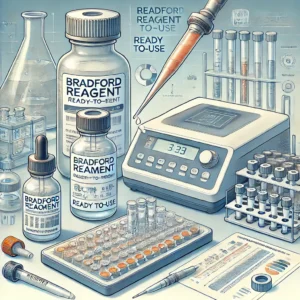
Key Features of Bradford Reagent (Ready-to-Use)
- Convenience
- Pre-prepared and ready to use, eliminating the need for reagent preparation and reducing errors during assay setup.
- High Sensitivity
- Detects protein concentrations as low as 1 µg/mL, suitable for a wide range of applications, including dilute samples (NIH.gov).
- Rapid Assay Time
- Provides results within minutes, making it ideal for high-throughput protein quantification (PubMed.ncbi.nlm.nih.gov).
- Robust and Reliable
- Minimal interference from salts, detergents, and reducing agents compared to other protein quantification methods (NIST.gov).
- Versatile Applications
- Compatible with various sample types, including cell lysates, purified proteins, and tissue extracts.
How the Bradford Assay Works
- Dye Binding
- The Coomassie dye interacts with protein residues, particularly arginine, lysine, and histidine, in an acidic environment.
- Color Change
- Upon binding, the dye shifts from red (absorbance maximum ~465 nm) to blue (absorbance maximum ~595 nm).
- Quantification
- The intensity of the blue color is directly proportional to the protein concentration and is measured using a spectrophotometer or microplate reader.
Applications of Bradford Reagent
- Protein Concentration Estimation
- Quickly determines protein concentrations in samples before downstream applications like SDS-PAGE, Western blotting, and enzymatic assays.
- High-Throughput Screening
- Suitable for rapid quantification in 96- or 384-well microplate formats, enabling large-scale protein analyses (FDA.gov).
- Biotechnology and Pharmaceuticals
- Widely used for quality control in protein-based therapeutics, ensuring accurate formulation (NCBI.gov).
- Academic and Clinical Research
- Essential for protein studies in proteomics, enzymology, and structural biology (Genome.gov).
Advantages of Bradford Reagent Over Other Protein Quantification Methods
| Feature | Bradford Assay | BCA Assay | UV Absorbance |
|---|---|---|---|
| Sensitivity | Moderate | High | Moderate |
| Speed | Rapid (<5 min) | Slower (~30 min) | Immediate |
| Interference Resistance | Minimal interference | Sensitive to reducing agents | Sensitive to nucleic acids |
| Ease of Use | Simple, ready-to-use reagent | Requires reagent preparation | Requires spectrophotometer |
Protocol for Using Bradford Reagent (Ready-to-Use)
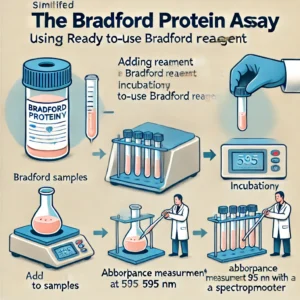
- Prepare Standards and Samples
- Dilute a known protein standard (e.g., BSA) to create a standard curve.
- Prepare the sample by diluting as needed.
- Add Reagent
- Mix 1 part sample/standard with 5 parts Bradford reagent in a microplate or cuvette.
- Incubate
- Allow the reaction to develop for 5–10 minutes at room temperature.
- Measure Absorbance
- Measure the absorbance at 595 nm using a spectrophotometer or microplate reader.
- Quantify Protein
- Compare sample absorbance to the standard curve to calculate protein concentration.

Advantages of the Ready-to-Use Formulation
- Time-Saving
- No need to prepare stock solutions, ensuring faster assay setup.
- Consistency
- Eliminates variability in reagent preparation, leading to reproducible results.
- Ease of Storage
- Stable at room temperature or refrigerated, with a long shelf life.
Tips for Optimal Results
- Avoid Overloading
- Ensure protein concentrations fall within the linear range of the standard curve (1–100 µg/mL).
- Minimize Interference
- If detergents or reducing agents are present, consider alternative assays like the BCA assay.
- Mix Thoroughly
- Ensure thorough mixing of reagent and sample for consistent results.
Future Perspectives
- Enhanced Sensitivity
- Development of modified Bradford reagents for detecting ultra-low protein concentrations (NIST.gov).
- Automation
- Integration with robotic liquid-handling systems for high-throughput workflows (NIH.gov).
- Portable Assays
- Development of portable, field-ready devices using Bradford reagent for on-site protein analysis (FDA.gov).
Conclusion
The Bradford Reagent (Ready-to-Use) remains a cornerstone for protein quantification due to its speed, convenience, and reliability. Whether for routine laboratory analyses or high-throughput applications, this reagent provides accurate results with minimal preparation, making it an essential tool for researchers across various fields.
For more details, refer to resources such as NIH.gov, FDA.gov, and Genome.gov.