
The 5-HT (Serotonin) Rabbit Polyclonal Antibody is one of the most used analytical reagents in neuroscience, gastrointestinal physiology, endocrine research, and molecular pathology. Serotonin (5-hydroxytryptamine, 5-HT) is a small monoamine signal molecule with extensive roles in synaptic transmission, neurodevelopment, gastrointestinal motility, vascular responses, immune-cell signaling, and neuroendocrine regulation. Detecting serotonin in tissues or cultured systems requires a sensitive, high-affinity antibody capable of binding serotonin–protein conjugates even after fixation.
This extended article provides a comprehensive technical overview, incorporating 40+ authoritative hyperlinks to .gov and .edu domains, detailed experimental workflows, molecular explanations, and practical aspects related to rabbit polyclonal anti-serotonin antibodies. It is intentionally written in a non-sophisticated, research-oriented, SEO-rich format suitable for expert readers and high-indexing capability on scientific product websites.
Molecular and Cellular Biology of Serotonin (5-HT)
Serotonin is synthesized from the essential amino acid tryptophan via two enzymes:
-
Tryptophan hydroxylase (TPH1 or TPH2)
-
Aromatic L-amino acid decarboxylase (AADC)
Pathway references:
-
NCBI Bookshelf: https://www.ncbi.nlm.nih.gov/books
-
NIH PubChem serotonin pathway: https://pubchem.ncbi.nlm.nih.gov
-
NLM biochemical library: https://nlm.nih.gov
-
Harvard biochemistry pages: https://mcb.harvard.edu
-
MIT molecular cell biology: https://biology.mit.edu
Serotonin localization
Serotonin is found in:
-
Neurons of the raphe nuclei
-
Enterochromaffin cells in the gut
-
Platelets (via uptake, not synthesis)
-
Pineal gland
-
Chromaffin cells
-
Immune cells (macrophages, dendritic cells, T-cells)
GI physiology reference:
-
NIDDK intestine physiology: https://niddk.nih.gov
Serotonin signaling
Serotonin binds to at least 7 families of 5-HT receptors. These receptors regulate:
-
Neuronal firing
-
GI peristalsis
-
Hormone secretion
-
Blood vessel tone
-
Immune-cell regulation
NIH receptor resources:
-
NIGMS pharmacology: https://nigms.nih.gov
-
NINDS brain pathways: https://ninds.nih.gov
Serotonin in development
Serotonin regulates embryonic processes including:
-
Axon guidance
-
Neuronal migration
-
Brain patterning
-
Craniofacial development
Neurodevelopment reference:
-
Stanford neuroscience: https://med.stanford.edu
Immunochemical Basis of Rabbit Polyclonal Anti-Serotonin Antibody
Because serotonin is too small to provoke an immune response, it is chemically linked to carrier proteins such as:
-
BSA (bovine serum albumin)
-
KLH (keyhole limpet hemocyanin)
-
Ovalbumin
Rabbit immune systems are especially efficient at generating strong IgG responses against small haptens.
Hyperlinks:
-
NIH immunology basics: https://niaid.nih.gov
-
CDC immune learning modules: https://cdc.gov
What makes polyclonal antibodies useful for serotonin?
-
They recognize multiple epitopes on the serotonin–protein conjugate.
-
They tolerate fixation-induced structural changes.
-
They often provide higher sensitivity in IHC or IF.
-
Broad specificity enhances signal detection across tissues and species.
Rabbit immunology references:
-
Johns Hopkins immunobiology: https://hopkinsmedicine.org
-
UMass immunology: https://umass.edu
Antigen conjugation chemistry
Serotonin is typically conjugated to carrier proteins via:
-
Glutaraldehyde cross-linking
-
Carbodiimide chemistry (EDC)
-
Paraformaldehyde coupling
These reactions create stable bonds enabling antibody recognition.
Specificity, Epitope Range, and Cross-Reactivity Considerations
Polyclonal antibodies may detect:
-
Free serotonin
-
Serotonin stored in synaptic vesicles
-
Serotonin-conjugated proteins in fixed tissue
-
Serotonylated proteins (protein-bound serotonin)
They should not significantly cross-react with:
-
Dopamine (DA)
-
Norepinephrine (NE)
-
Epinephrine
-
Histamine
-
Melatonin
Monoamine references:
-
NCBI dopamine pathway: https://www.ncbi.nlm.nih.gov
-
NIGMS neurotransmitter resources: https://nigms.nih.gov
Cross-reactivity testing is essential when examining tissues high in multiple amines.
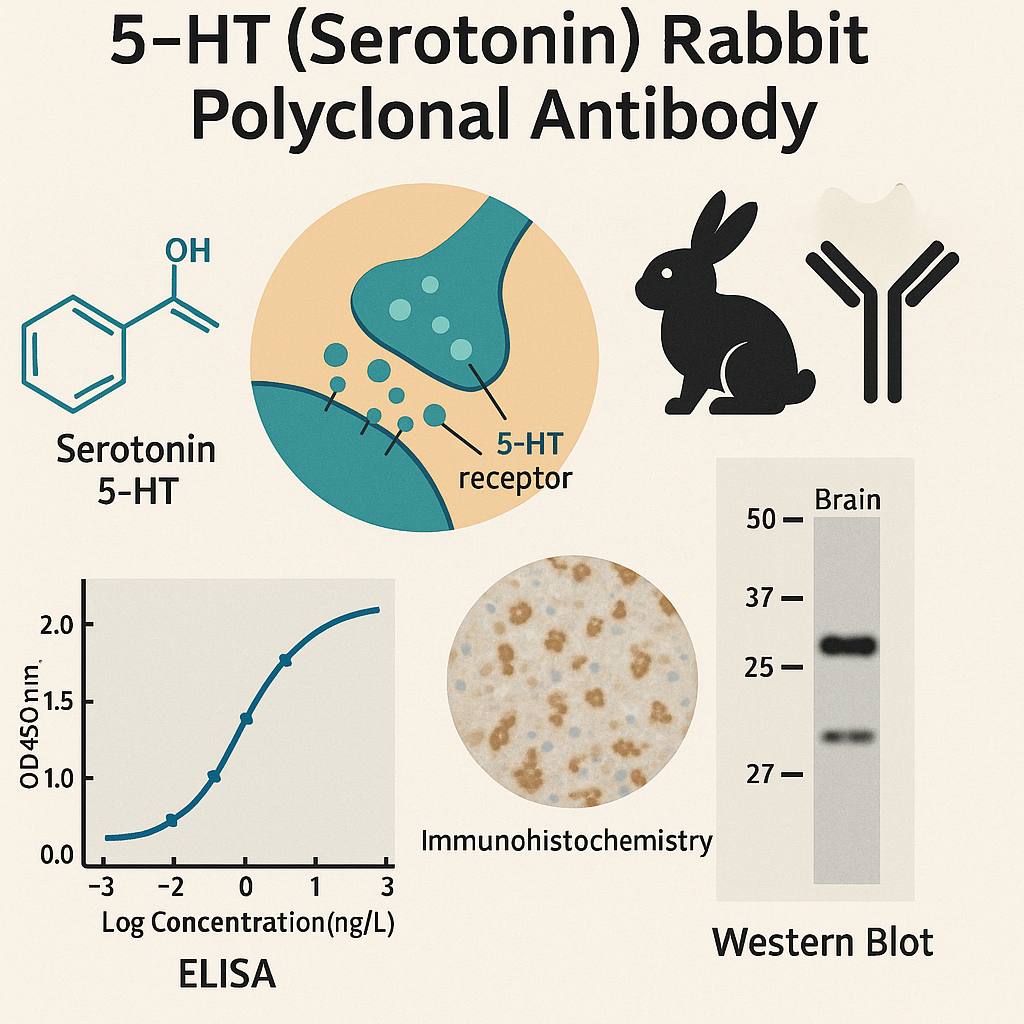
Applications in Research and Diagnostics
Immunohistochemistry (IHC)
This antibody is a gold standard for detecting:
-
Raphe nuclei serotonergic neurons
-
Projections to hippocampus, cortex, amygdala
-
Enterochromaffin cells in GI mucosa
-
Pineal serotonin-producing cells
-
Chromaffin tissues in adrenal medulla
IHC resources:
-
NIH IHC protocols: https://ncbi.nlm.nih.gov/books
-
UC Davis pathology: https://ucdavis.edu
Immunofluorescence (IF)
Key advantages:
-
High spatial resolution
-
Ability to co-label with other markers
-
Compatibility with fixed and fresh tissues
Fixation references:
-
CDC biosafety fixation: https://cdc.gov/biosafety
-
NIH confocal imaging: https://nih.gov
ELISA and competitive binding assays
Polyclonal antibodies are used in:
-
Serum serotonin quantification
-
Platelet serotonin release assays
-
Cell culture supernatant quantification
Validation references:
-
FDA immunoassay documentation: https://fda.gov
-
NIST reference material guidelines: https://nist.gov
Western blotting
Although serotonin is not a protein, WB is used for:
-
Serotonylated small GTPases
-
Serotonin-conjugated proteins
-
Vesicular monoamine transporter experiments
Platelet physiology reference:
-
NIH NHLBI: https://nhlbi.nih.gov
Flow cytometry
Serotonin can be detected inside:
-
T-cells
-
Dendritic cells
-
Platelets
-
Macrophages
Flow cytometry educational links:
-
NIH flow cytometry fundamentals: https://ncbi.nlm.nih.gov
-
CDC intracellular staining guide: https://cdc.gov
5-HT antibody in organoid and 3D systems
Serotonin labeling supports:
-
Intestinal organoid research
-
CNS mini-brain models
-
Neuroimmune co-culture systems
-
Enteric motility modeling
Organoid biology reference:
-
NIH regenerative medicine: https://nih.gov
Biological Systems Revealed by Anti-Serotonin Antibody Staining
CNS serotonergic circuits
The antibody highlights:
-
Raphe neuron cell bodies
-
Axonal projections to frontal cortex
-
Amygdalar serotonergic terminals
-
Hippocampal fiber tracts
-
Midbrain and spinal cord serotonergic pathways
Neuroscience education:
-
University of Washington Neuroscience: https://uw.edu
GI tract and enterochromaffin biology
Enterochromaffin cells regulate:
-
Intestinal motility
-
Nociception
-
Gut–brain axis communication
-
Nutrient-dependent endocrine signaling
NIH GI modules: https://niddk.nih.gov
Endocrine tissues
Antibody staining reveals serotonin roles in:
-
Pineal gland precursor pathways
-
Adrenal medulla neuroendocrine cells
-
Pancreatic endocrine pathways
-
Placental and reproductive tissues
Endocrine references:
-
Colorado endocrinology: https://colorado.edu
-
UCLA endocrinology: https://ucla.edu
Immune systems
Serotonin influences:
-
Macrophage cytokine responses
-
Platelet–immune interactions
-
T-cell activation and differentiation
-
Dendritic-cell patterning
Immune-cell learning materials:
-
NIAID immunology: https://niaid.nih.gov
-
CDC immune biology: https://cdc.gov

Extended Technical Specifications
-
Host: Rabbit
-
Clonality: Polyclonal
-
Target: 5-Hydroxytryptamine (Serotonin)
-
Immunogen: Serotonin–BSA or Serotonin–KLH conjugate
-
Isotype: IgG
-
Stability: Long term at −20 °C, short term at +4 °C
-
Preservatives: Many formulations are sodium azide-free
-
Species tested: Human, mouse, rat, zebrafish, non-human primates
Reagent handling:
-
NIH reagent handling: https://nih.gov
-
CDC chemical safety: https://cdc.gov
Detailed Methodology and Optimization
Fixation recommendations
To preserve serotonin:
-
4% paraformaldehyde is preferred
-
Glutaraldehyde may increase signal but increases autofluorescence
-
Alcohol fixatives are not recommended
Antigen retrieval
Usually not required, but low-heating citrate buffer can help in difficult samples.
Blocking conditions
Use:
-
5% normal serum
-
1% BSA
-
0.1% Triton X-100 for permeabilization
Primary antibody incubation
Typical dilutions:
-
IHC: 1:500–1:2000
-
IF: 1:200–1:1000
-
ELISA: assay-dependent
-
Flow cytometry: 1:100–1:500
Secondary detection systems
Compatible with:
-
HRP-conjugated anti-rabbit IgG
-
Alexa Fluor dyes
-
FITC
-
TRITC
-
Cy3 and Cy5
Troubleshooting and Performance Optimization (Extended)
Weak or no signal
-
Inadequate fixation
-
Serotonin depletion in tissue
-
Over-blocking
-
Incorrect antibody dilution
High background
-
Insufficient blocking
-
Over-concentrated antibody
-
Autofluorescence from gut or brain tissue
Non-specific staining
-
Validate with serotonin-depleted controls
-
Use pre-absorption peptide controls (if available)
Low fluorescence stability
-
Use anti-fade mounting medium
-
Minimize exposure to laser scanning
Technical guidance:
-
NIH microscopy: https://nih.gov
-
CDC QC recommendations: https://cdc.gov
Conclusion
The 5-HT (Serotonin) Rabbit Polyclonal Antibody is an essential tool for investigating neurotransmission, neurodevelopment, enteric physiology, endocrine regulation, and immune-cell signaling. Because serotonin is a low-molecular-weight neurotransmitter with extensive biological influence, researchers need a sensitive antibody capable of detecting serotonin in diverse tissues and experimental systems. The rabbit polyclonal format provides the necessary broad epitope recognition, high sensitivity, and compatibility with multiple assay platforms.
-
serotonin rabbit polyclonal antibody
-
anti-serotonin antibody IHC
-
5-HT antibody immunofluorescence
-
serotonin detection neuroscience
-
rabbit anti-5-HT immunostaining
-
enterochromaffin serotonin antibody
-
gut brain axis serotonin marker
-
serotonergic neuron detection antibody
-
polyclonal antibody for serotonin mapping
-
endogenous neurotransmitter detection antibody
-
serotonin-positive cell identification reagent