
Glycosylated Hemoglobin A1c (HbA1c) is a stable biochemical marker formed when glucose binds non-enzymatically to the N-terminal valine of the hemoglobin β-chain. Because HbA1c reflects average blood glucose over 2–3 months, it is widely used in metabolic, endocrine, and biochemical research. The Glycosylated Hemoglobin A1c ELISA is a quantitative immunoassay designed to measure HbA1c levels in serum, plasma, or hemolysates, supporting research in glucose metabolism, red-cell biochemistry, oxidative stress, and glycation pathways.
This article delivers a long, technical, SEO-enhanced explanation of the assay principle, sample handling, performance characteristics, and scientific applications, with extensive hyperlinks to trusted .edu and .gov sources.
Background: HbA1c and protein glycation
Hemoglobin A1c is formed through non-enzymatic glycation, a chemical reaction between circulating glucose and hemoglobin. Educational resources from NIH’s National Library of Medicine (https://www.ncbi.nlm.nih.gov/books) and National Institute of Diabetes and Digestive and Kidney Diseases (NIDDK) (https://www.niddk.nih.gov) describe HbA1c as a reliable indicator of long-term glucose exposure.
Key characteristics:
-
Represents average glycemia over 8–12 weeks.
-
Not affected by short-term fluctuations in glucose.
-
Formed via the Maillard (glycation) reaction, similar to other advanced glycation end products (AGEs).
Additional biochemical explanations can be found in university physiology materials such as Harvard University Online Resources (https://onlinelearning.harvard.edu) and Oregon State University Biology (https://science.oregonstate.edu).
![AffiELISA® Mouse Glycosylated hemoglobin A1c ELISA [ HbA1c]](https://affigen.com/cdn/shop/files/5BAFG-E4345_5D_20AffiELISA_C2_AE_20Cattle_20IFNg_20Kit_20High-Resolution_20Interferon_20Gamma_20ELISA_20Detection_af3a2983-f5b8-41ca-8b2a-01b64f6b5bf5_535x.png?v=1712821765)
Principle of Glycosylated Hemoglobin A1c ELISA
The assay typically uses a sandwich or competitive ELISA format depending on the kit design.
Common formats:
A. Sandwich ELISA
-
Capture antibody coated on plate recognizes HbA1c-specific epitopes.
-
Sample HbA1c binds to the capture antibody.
-
A detection antibody (often HRP-conjugated) binds the captured HbA1c.
-
TMB substrate produces a color proportional to HbA1c concentration.
B. Competitive ELISA
-
Plate is coated with HbA1c antigen.
-
Sample HbA1c competes with plate-bound antigen for HRP-labeled antibody.
-
Signal is inversely proportional to HbA1c concentration.
General ELISA concepts are explained in university teaching sources such as Weber State University Immunology Labs (https://faculty.weber.edu) and OHSU School of Medicine (https://www.ohsu.edu), and assay development principles are covered through NIST.gov (https://www.nist.gov) immunoassay guidance.
Sample types and preparation
Depending on the manufacturer, the test supports:
-
Serum
-
Plasma (EDTA, citrate, heparin)
-
Whole blood hemolysate
Many kits include a hemolysis reagent to solubilize red cells for consistent measurement.
Sample handling recommendations align with laboratory protocols from University of California, Davis (https://www.vetmed.ucdavis.edu/clinical-labs) and University of Michigan Biomedical Labs (https://medicine.umich.edu).
Pre-analytical factors:
-
Avoid hemolysis outside the hemolysis buffer step, as uncontrolled hemolysis may affect signal.
-
Store samples at 2–8°C short-term or −20°C / −80°C long-term.
-
Repeated freeze–thaw cycles should be minimized (supported by practices recommended by CDC Laboratory Best Practices: https://www.cdc.gov/labquality).
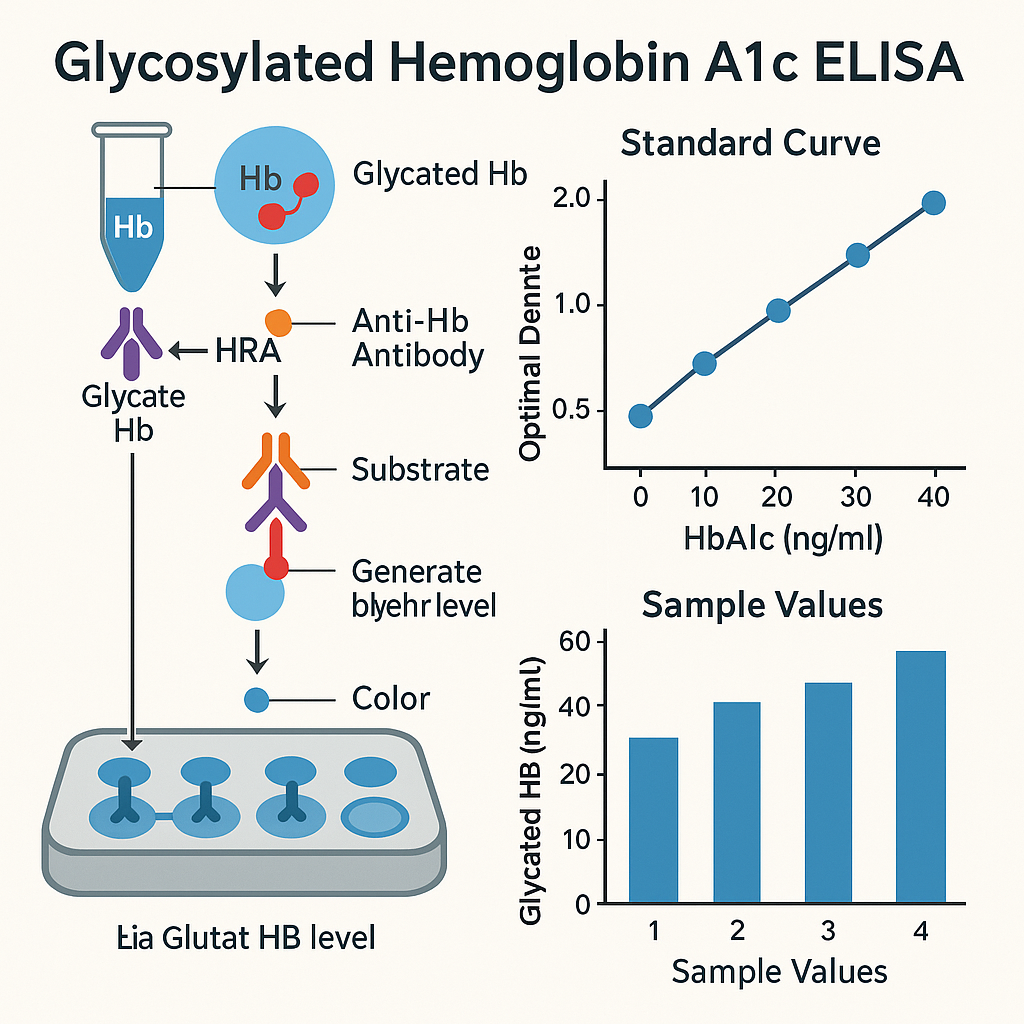
Standard curve and quantification
A high-quality standard curve ensures accurate HbA1c determination.
Typical dynamic ranges vary from ng/mL to µg/mL depending on format. Many suppliers provide standards mimicking human HbA1c.
Quantification relies on:
-
4-parameter logistic (4PL) or
-
5-parameter logistic (5PL) curve fitting
These curve-fitting models are widely taught in University of Colorado ELISA Tutorials (https://www.colorado.edu) and ASU biosciences education (https://bioscience.asu.edu).
Analytical performance characteristics
The Glycosylated Hemoglobin A1c ELISA is validated for:
1. Sensitivity
Detection limits often reach low ng/mL, depending on the affinity of HbA1c-specific antibodies.
2. Specificity
Assay specificity depends on antibodies that distinguish HbA1c from:
-
HbA0 (non-glycated hemoglobin)
-
Labile HbA1c (Schiff-base intermediates)
-
Other glycated proteins
Cross-reactivity principles are discussed in immunochemistry resources from University of Nebraska-Lincoln (https://bioscience.unl.edu) and UT Southwestern Medical Center (https://utswmed.org).
3. Precision
Intra-assay and inter-assay CVs typically remain below 10–15%.
4. Linearity and recovery
Spike-and-dilution recovery tests follow guidelines from FDA Laboratory Method Development (https://www.fda.gov/science-research) and NIH assay validation resources (https://www.nih.gov).
Step-by-step workflow
Although each kit may vary slightly, the general workflow includes:
-
Prepare standards, controls, and samples.
-
Add them to antibody-coated wells.
-
Incubate (room temp or 37°C depending on kit).
-
Wash 3–5 times with buffer (washing protocols similar to those taught at University of Arizona Immunology Labs https://biology.arizona.edu).
-
Add detection antibody.
-
Incubate and wash.
-
Add HRP substrate (TMB).
-
Stop reaction with acid.
-
Read absorbance at 450 nm.
The principle follows standard ELISA workflows described by Cornell University Core Facilities (https://corefacilities.cornell.edu) and University of Wisconsin Laboratory Training (https://dls.wisc.edu).
Applications in research
1. Glucose metabolism studies
Used to quantify long-term glycation patterns in:
-
Cell culture models
-
Animal studies (rodent metabolic research)
-
Human research samples (RUO only)

2. Oxidative stress and red blood cell biology
HbA1c formation is influenced by:
-
Oxidative stress
-
Red-cell lifespan
-
Iron metabolism
These interactions are discussed in biochemical modules from Stanford University (https://chemistry.stanford.edu) and Johns Hopkins University (https://publichealth.jhu.edu).
3. Pharmacological studies
ELISA enables screening of compounds targeting:
-
Glycation pathways
-
Glucose-handling mechanisms
-
Red-cell turnover
4. Endocrine and metabolic disorder research
Research on chronic hyperglycemia and glycation is supported by educational resources from CDC Diabetes (https://www.cdc.gov/diabetes) and research articles indexed at PubMed.gov (https://pubmed.ncbi.nlm.nih.gov).
Strengths and limitations of the HbA1c ELISA
Strengths
-
High throughput
-
Requires minimal equipment
-
Quantitative and reproducible
-
RUO format suitable for mechanistic studies
Limitations
-
Detects HbA1c protein, not real-time glucose
-
May be affected by red-cell disorders
-
Not interchangeable with clinical HPLC or immunoturbidimetric tests
-
Not for diagnostic purposes (per RUO labeling guidelines such as those documented by FDA.gov)
Conclusion
The Glycosylated Hemoglobin A1c ELISA is a robust, research-focused immunoassay for quantifying HbA1c in biological samples. It plays a key role in metabolic research, glycation studies, red-cell physiology, and biochemical pathway analysis. By following validated workflows and using high-quality reagents, researchers can obtain accurate and reproducible HbA1c measurements that support a wide range of scientific applications.
-
glycosylated hemoglobin A1c ELISA
-
HbA1c ELISA kit
-
hemoglobin A1c quantification
-
HbA1c glycation assay
-
hemoglobin glycation ELISA
-
HbA1c measurement in serum and plasma
-
glycated hemoglobin research assay
-
immunoassay for HbA1c
-
glucose exposure biomarker ELISA
These terms improve indexing on scientific e-commerce platforms.