Introduction
Polymerase Chain Reaction (PCR) is a powerful and versatile tool widely used in molecular biology, diagnostics, and research. It is used to amplify specific segments of DNA or RNA, enabling researchers and clinicians to detect and quantify nucleic acids with great sensitivity. However, given its importance and sensitivity, PCR is susceptible to various sources of error, including contamination, reagent variability, instrument malfunction, and operator error. To mitigate these risks and ensure the reliability and accuracy of PCR results, external quality control (EQC) is a critical component of any PCR laboratory’s quality assurance program.
![AffiCHECK® BD Max™ Staphylococcus aureus (MSSA) PCR External Quality Control [Mid Level]](https://affigen.com/cdn/shop/products/AffiCHECK_e427ff93-06ab-4a3f-a54c-0e98913cfd5e_535x.png?v=1686503350)
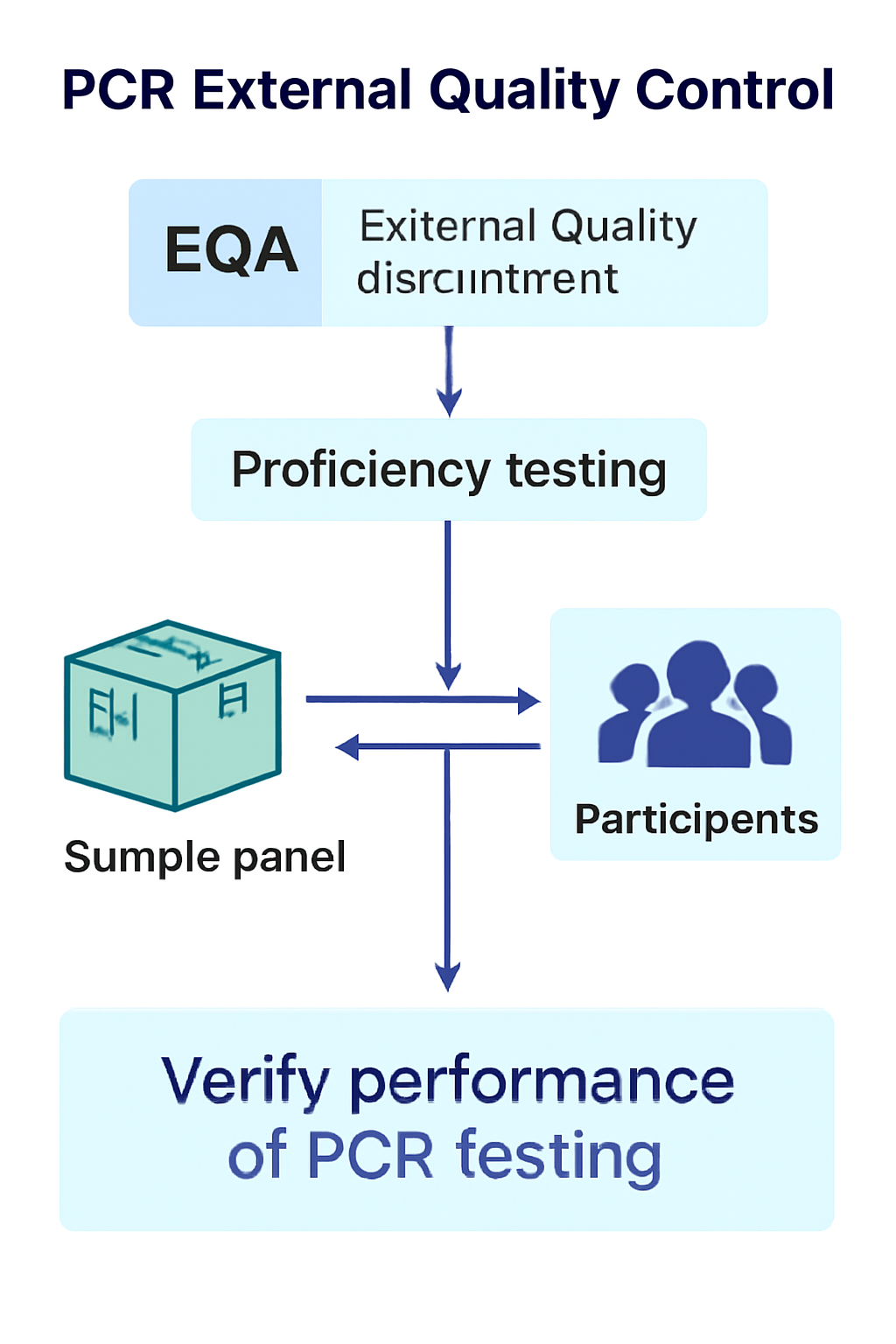
External Quality Control (EQC) programs provide an essential framework for assessing the performance of PCR assays across different laboratories. These programs, which involve the use of proficiency testing (PT) and inter-laboratory comparisons, allow laboratories to identify performance issues, improve accuracy, and demonstrate compliance with regulatory and accreditation requirements.
This comprehensive article provides a deep dive into PCR external quality control, exploring its significance, implementation strategies, and how it fits into a broader quality management system for molecular diagnostics and research. The article will also highlight the regulatory and academic resources, featuring hyperlinks to authoritative government (.gov) and educational (.edu) websites for further technical reference.
The Need for External Quality Control (EQC) in PCR
Ensuring Accuracy and Reproducibility
PCR is a technique that relies on precise amplification and detection of nucleic acids. Even small errors during the preparation, amplification, or detection processes can lead to inaccurate results. Contamination, improper reagent handling, or suboptimal equipment calibration can all introduce significant variation, making it essential to have an external system in place to validate the accuracy and reproducibility of results.
As highlighted in a study published by the National Institutes of Health (NIH), maintaining accurate PCR results requires continuous oversight, particularly when assays are used for clinical diagnostics. Inaccurate PCR results can lead to incorrect diagnoses, false positives/negatives, and compromised research findings. (ncbi.nlm.nih.gov)
By utilizing external quality control programs, laboratories can monitor their performance against standardized benchmarks, ensuring that their PCR assays remain accurate and consistent over time.
Regulatory Compliance and Accreditation
Many laboratories, especially those in clinical diagnostics, are required to comply with various regulatory standards. In the United States, laboratories must meet the requirements set forth by the Clinical Laboratory Improvement Amendments (CLIA), which include maintaining proficiency in PCR testing. Similar standards exist in other regions, such as ISO 15189 for medical laboratories globally.
Accreditation bodies and regulatory agencies often require laboratories to participate in EQC programs as a condition for certification. For example, the College of American Pathologists (CAP), which offers laboratory accreditation in the United States, mandates participation in proficiency testing for molecular diagnostics. Laboratories that fail to meet EQC standards may face consequences, including the loss of accreditation or certification.
External quality control programs provide an objective way for laboratories to demonstrate their compliance with these standards. Participation in external proficiency testing rounds, comparison of results to peers, and addressing discrepancies through corrective actions are critical for maintaining accreditation and ensuring high-quality patient care.
Enhancing Laboratory Competency and Benchmarking
Another significant advantage of EQC is that it allows laboratories to benchmark their performance against other labs in the same field. This is particularly useful for laboratories that perform PCR for high-stakes diagnostics, such as pathogen detection, genetic testing, and forensic analysis.
A study published by the European Centre for Disease Prevention and Control (ECDC) noted that inter-laboratory comparisons help identify discrepancies in laboratory techniques, whether related to sample handling, reagent variation, or instrumentation. By comparing their performance with peers, laboratories can identify areas for improvement and implement corrective actions that raise the overall competency of the laboratory. (ecdc.europa.eu)
Furthermore, participation in EQC programs helps laboratories gain credibility and trust within the scientific and medical communities. Laboratories that consistently perform well in proficiency testing rounds demonstrate their ability to deliver reliable results, fostering confidence among their clients and regulatory bodies.
Components of PCR External Quality Control
1. External Control Materials
A crucial element of EQC programs is the use of external control materials, which simulate real patient samples or experimental samples and are distributed to participating laboratories. These control materials allow laboratories to evaluate the performance of their PCR assays across a variety of conditions.
The selection of appropriate control materials is vital to ensure that the external controls challenge the laboratory’s PCR process from start to finish, including sample extraction, amplification, and detection. For example, control materials should include:
-
Negative controls: These are samples that do not contain the target DNA/RNA, helping to detect contamination or false positives.
-
Low-positive controls: These samples contain low amounts of the target DNA/RNA, challenging the assay’s sensitivity and ability to detect weak signals.
-
Spike controls: These are samples with known amounts of target DNA/RNA that are spiked into matrix materials to assess the assay’s ability to detect and quantify target molecules in complex biological matrices.
The Environmental Protection Agency (EPA) provides comprehensive guidelines for selecting and preparing external controls in PCR assays for environmental testing. These materials are designed to replicate environmental samples as closely as possible, ensuring that the PCR assays are thoroughly tested for robustness and reliability. (epa.gov)
2. Proficiency Testing (PT) and Inter-Laboratory Comparisons
Proficiency testing involves distributing identical control samples to multiple laboratories, which then process and analyze the samples using their routine PCR protocols. Once results are submitted, they are compared against predefined “expected” results or against the collective performance of all participating laboratories.
Proficiency testing provides valuable insights into a laboratory’s performance, highlighting areas where the lab may need to adjust procedures or improve techniques. For example, during a round of proficiency testing for SARS-CoV-2 PCR assays, participating laboratories reported different levels of sensitivity, which highlighted the need for better standardization in PCR diagnostics for COVID-19 testing. (jmdjournal.org)
External proficiency testing can also identify trends in performance across laboratories, which may be indicative of larger systematic issues, such as inconsistencies in reagent quality or variations in equipment calibration. As laboratories often perform different aspects of the PCR workflow (extraction, amplification, detection), inter-laboratory comparisons ensure that the entire PCR process is evaluated.
3. Monitoring and Data Analysis
Once external controls are run and results are reported, laboratories must track and analyze their performance over time. The University of California, Davis Real-Time PCR Core Facility provides an extensive procedure for tracking PCR assay performance, using tools such as Levey-Jennings charts, to detect any trends or shifts in the results. Monitoring the data over extended periods allows labs to identify subtle variations in assay performance that may otherwise go unnoticed. (pcrlab.vetmed.ucdavis.edu)
By closely analyzing the results from external controls, laboratories can identify potential issues such as:
-
Reagent degradation over time
-
Instrument malfunctions or drift
-
Operator errors
-
Contamination sources

Corrective Actions and Continuous Improvement
When discrepancies arise between a laboratory’s results and the expected outcomes from external proficiency testing, corrective actions are required. These actions may include revisiting the PCR protocols, calibrating instruments, or retraining laboratory personnel. Corrective actions should be well-documented, and follow-up testing should be conducted to verify that the issue has been resolved.
Continuous improvement is a key aspect of maintaining high-quality PCR results. Laboratories should regularly review their external quality control practices, including the frequency of proficiency testing, the selection of external control materials, and the implementation of corrective actions. As new reagents, technologies, and methodologies emerge, laboratories must adapt their quality control practices to ensure that their PCR assays remain robust and accurate.
Conclusion
External quality control is an essential element in maintaining the integrity, accuracy, and reliability of PCR assays. By participating in proficiency testing, using external control materials, and monitoring performance over time, laboratories can identify and address potential issues before they affect diagnostic outcomes or research results.
For laboratories involved in PCR testing, whether for clinical diagnostics or research, implementing a robust external quality control program is not just a regulatory requirement — it is essential to ensure high-quality, reproducible results. By regularly assessing and improving their PCR workflows, laboratories can help ensure that PCR technology continues to serve as a reliable and accurate tool for molecular diagnostics and research.